Wednesday, May 13, 2020


My New Code Blog

Computer software is something that I'm very interested in.  I've been very fortunate in that something that I have an interest in is also something that one can get paid to do, not that you always get to build things that you find innately interesting !

The whole time on the job over the years, I've always had side projects and side investigations that I've worked on out of personal interest.  These languish away on various storage media perhaps to be re-read some day perhaps not.

I've been helped a lot at times by various random people who have posted up their examples and findings when it comes to considering some software problem or other, it finally occurred to me that maybe someone else might find something that I've done to be helpful to them.

So, I've started my own Code Blog.   I hope the search engines find some of the articles on the chance that someone out there might find something useful or interesting them as I found other's stuff interesting and helpful to me.

Here it is:

Click me to visit the Code Blog !

Wednesday, November 27, 2019

Two Wheels Good

A play on Orwell's critique of the dangers of extreme ideology politics in his novel 'Animal Farm'.


In Animal Farm, the working farm animals overthrew their human masters with the rallying cry:
   4 legs good, 2 legs bad.

Applied to the world of motorized transportation, this slogan was coined sometime in the 80's: 
   2 wheels good, 4 wheels (you figure the rest out...)


IMHO adherence to ideological extremes are something that thoughtful people that self identify with the 'left' or the 'right' might do well reflect on in the USA today for all the harm to innocent people that this causes.   History is replete with cases of innocent individuals who had become labelled as a member of some enemy class or group or other and once someone has been declared to be a member of this class, humankind has no shortage of individuals that know 'just what to do with them'.
  
(Note:  I have friends that own cars.  In fact I myself have a car.  It is indeed possible to be a decent human being while simultaneously having a motorcycle, a bicycle AND a car)

What is it that draws people to transportation on 2 wheels when there is so much more convenience and comfort to be had on 4 ?

Noted Career Counselor Marty Nemko, for whom I have a lot of respect, once opined on one of his radio shows that he could not understand why anybody would spend the money to buy an overpriced Harley-Davidson Motorcycle when you can get a reliable Toyota Corolla for less money.  That such a choice makes absolutely no sense.

Here's the thing about 2 wheeled travel as opposed to 4.
People spend time and money to go to amusement parks towards no practical end.
It can be argued that there is nothing productive or 'socially redeeming' about riding a roller coaster, yet many people enjoy the experience enough to make and pay money to have the experience.

2 wheeled travel can be like having a roller coaster ride on demand, at your convenience.

Shed of an insulating shell, travel on 2 wheels exposes you to your environment.

You experience everything immediately.

On a cold but sunny morning, come around a corner off of a mountain and into a valley and the feel the chill give way to radiant warmth.

The whistle of the air flowing around you (good when you want it, bad when you don't) carrying with the smell of the flowers you see all around you.

Bank the machine into a corner and take in the sensation and view from your body hovering inches off of the ground which is rushing just beneath you, you can glance down to SEE it speeding by, up close, right in front of your eyeballs.

You don't get anything like this when driving a passenger car or truck.  (exception noted for performance car driving which offers it's own kind of sensory involvement)

Bicycle riding has been part of my adult life for decades.

Aside from utilitarian bicycle riding for local transportation and commuting to work I also enjoy riding a bicycle for recreation.  This kind of riding often involves putting the bicycle on a conveyance to get to a remote starting point.   There is the conventional method for getting there:  put the bike(s) in/on a car/truck and drive or perhaps get on a train or plane with the bike(s) as luggage. 

When I've packed up and drove for this kind of ride, it would often strike me as a waste of a good day to be spending part of it sitting in a car when I'd much rather be on a bike, the motorized kind.
The obvious solution was to find a way to do both.   While not common, I'm not the only one to have invested the effort towards this end, but here's my take on it.

Scenes from 2 decades of MC bicycle fun:


Somewhere in Montana on the way to Minnesota for a special 4th of July celebration bicycle ride:


Epic winter AZ get away
   over a freezing snowy pass on the way:


out to the desert and warmer climes at last:


Returning from another July 4th bicycle ride in Minnesota, this time stopping at the Mitchell Corn Palace in, where else ?  Mitchell,  South Dakota.   The graphics on the exterior of the Corn Palace venue are rendered in, what else ?  Corn !:


Death Valley MTB haul sometimes you just have to get off of pavement:


Local scenic ride:
   Phenomenal Kawasaki ZX-14R capable of going from 0 mph to a speed of 100 mph in just 4.8 seconds (but I don't have the nerve to try it).
   The Extremes of 2 wheeled travel during the same outing !


2 wheels good !  Oh yeah !

Thursday, March 15, 2018

March 14th 'Pi Day' isn't...

Yesterday March 14th was 'Pi Day'.   A play on the first 3 digits of pi  3.14.

Pi of course is the ratio of the circumference of a circle with its diameter, the longest length you can measure from one point of a circle to a different point.  This ratio has immense theoretical and practical importance and so is taught just about world wide wherever mathematics is valued.

Some businesses have seized on the novelty of this day by offering business opportunities such as:

Well, it turns out that really:

Why ?

'Pi' is a greek letter.
Ask a Greek speaker to pronounce 'Pi' and they will not pronounce it as 'Pie' but rather they will say it 'Pee'.

So phonetically, it's not 'Pie day'  it's  'Pee day'.    No pies involved.

Of course one could argue that, in the US at least, everyone in math class agrees to pronounce it 'Pie' so since that is the convention then 'Pie' it is.

I prefer to go to a more fundamental route.
It's a Greek letter.  The Greeks pronounce it 'Pee', so it's 'Pee' and not 'Pie'.

I had a native Italian math teacher once and for a while no one could understand what he was talking about 'Pee' what ??

For the same reason, I will go out of my way to call a Porsche a 'Porsh-uh' and NOT a 'Porsh'.
And to the next degree out, I will call a Chevrolet a 'Shev-ro-lay' and not a 'Shev-ro-LET'.

As WC Fields, as Mr. Howard Bissonette, once put it, in reverse, about how to properly address his wife:

"Do not call Mrs. 'Bis-o-net'  Mrs.  'Bis-o-net',  it's 'Bis-o-nay'"

Ha ha ha !


Tuesday, March 13, 2018

Rediscover: The Fading Craft of Scale Model Airplane Construction !


Building Model Airplanes occupied for me a number of very pleasant childhood hours.   Hours turned to days turned to a beautiful model to show for the investment of time.

And it is an investment.

Each newly built model gains positively from the experience of having built all models previous.

This used to be a very popular hobby.   So popular that in the 60's you could walk into practically ANY variety store and find a few shelves of kits from which to choose the next project.  ("What's a *variety* store ?"   I guess that these days chain Drug Stores have become the new variety store carrying a limited selection of goods from a broad set of categories).

Fast forward to today and even a full blown specialized Hobby Store might NOT have ANY Scale Flying Model Airplanes in the store.   It's really a shame because the patience and craft developed in the act of building these things is really a satisfying set of skills to have because they can bleed over into just about any kind of precision construction task in which you might want to engage.

This kind of activity:  actually producing something by construction from raw materials and specifically NOT by assembling prefabricated parts seems to have risen in the last decade(+) or so.

The new name associated with this kind of activity is that is is work done by a 'Maker'. 

In the mainstream USA of those born in the 50s and 60s.   'Maker' didn't exist because practically every school age male took 'shop class'.  There was nothing special about being a 'Maker' back then, because every junior high school male was a Maker (maybe some girls too, but it was required of the boys).  Yah, the tax payers that provided me the gift of public school paid for me to learn how to be a 'Maker'.   Have to pay for that yourself today..   (NOTE:  being a pre-modern new male, in addition to the shop classes, I also signed up for the 'Girls Home Economic' cooking classes back then as well, I took a little heat for that).

My previous model building experience boosted me to the front of the wood and metal shop classes since the basics of careful fabrication and construction had already been learned.
The shop classes took it the next step towards the real world though.

The most memorable project of my metal shop class was to make a chisel.  A real usable chisel.

Gen-U-wine Chisel Recipe:

1.  Take a rod of high carbon tool steel and cut yourself a 4 inch cylinder section  (use a manual saw, very tiring.  I think this was to impress upon us just how much work using an electric tool is saving you).

2.  Heat the cylinder in a forge up to red-orange hot.   The steel is now malleable.  Holding the piece with tongs using one hand, use a hammer in your other hand to beat the end of the cylinder into a symmetrically tapered gradually flattened shape.  This is the 'chisel' end that will do the chiseling.
This can't be done in one go because the steel cools too quickly, so you have to reheat and shape the piece over a number of separate heating and shaping cycles (I think it took me about 10 rounds of heating and beating to get it to the shape that I wanted).

3.  With the basic shape set, now the piece is filed/grinded into it's final shape.
A 'V' shaped edge at the chisel end for cutting, a beveled edge around the circumference of the cylindrical opposite side, the 'hit with a hammer' side.   The bevel is there so that you cannot accidentally break and send off a dangerous flying projectile when you hit the chisel with a hammer.

4. Do some progressive rough to fine polishing so that the chisel has a smooth good looking finish.

5.  Now you have a piece of shaped steel that looks like a chisel, but it's an imposter.
If you try to use the 'chisel' now, you'll just bend big notches in what was your edge and you might also shatter the chisel into pieces. 
The edge is too soft to cut anything without losing its shape and the steel may also have brittle sections that cannot stand up to stress without breaking. 
So now you have to temper the steel so that it is resilient like a spring and will be able to absorb and return the impacts from hammer blows. 
Tempering is done by heating the steel to a specific temperature, partially quenching it into banded sections of graduated temperature by quickly dipping and pulling out the heated chisel into water at different depths.  The in air cooling of the entire chisel is now watched very carefully.   At the proper time during the cooling (it doesn't take long, only 10 seconds or less), you quench the entire piece completely by dropping it into the bucket of cooling water.  If you've done this correctly, the chisel now has the springy temper that will allow it to transmit the hammer blows without damage to the chisel.

6.  Now you must harden the cutting end of the chisel so that it will cut through 'normal steel'.  This is done by carbon case hardening.  (you might notice that the shackles of some padlocks are stamped with the words 'case hardened' on them, this is the same kind of hardening.  On a padlock, this makes the shackle harder to cut (hence a preferred tool of thieves is often a grinder)).

7.  NOW if you've done everything correctly you might have a chisel .
 In order to get a passing grade you have to prove that you have made a real chisel.
This is done by a very pleasing (I think) test:

Take the original rod of tool steel that was the source of the raw steel for your chisel and place your chisel on the end of it.
Strike your chisel hard with a hammer  (better wear eye protection for sure).
If you really have a chisel and not an imposer, your chisel will cleanly whack off a section of the original tool steel rod without ANY noticeable change in the appearance of the chisel and you will be able to do this repeatedly with the same results.

To be sure:

YOU HAVE MADE SOMETHING THAT IS STRONGER THAN THE ORIGINAL MATERIALS THAT YOUR PIECE WAS MADE FROM

You're a Maker. 
In that shop class, every boy is a Maker.
In that Junior High School every boy is a Maker.


Where was I ?

Oh, yeah   Model Airplane Building.

So the cool thing about building model planes is that not only are they scaled down versions of real planes, they are also aerodynamic in their own right and will fly.

In practice slight modifications to proportion may be done to make the model more flyable.

Q:  Why isn't an exact scaled down replica as flyable/stable as the original plane ?
A:  Because while you can scale down the proportions of the plane exactly, the air is NOT scaled down to match the model.   Aerodynamics depend on the bulk properties of air molecules.  Bulk properties depend on amounts.   The amount of air flowing over a real wing is not the same amount of air that is flowing over a model wing so the flight characteristics will be altered (consider the viscosity of air, for example).

Happily, for model buffs.   Many exact scale planes work well enough, and for many more slight alterations to the designs can improve the flight characteristics immensely.   An example:  adding a little more 'V' to shape of a wing when looked at from the front of the model (the dihedral) can offer a big increase in the flight stability of the model plane at a slight cost to the 'true to scale-ness'.


In a few pics here are a few very pleasing aesthetics of wood and paper model airplanes.


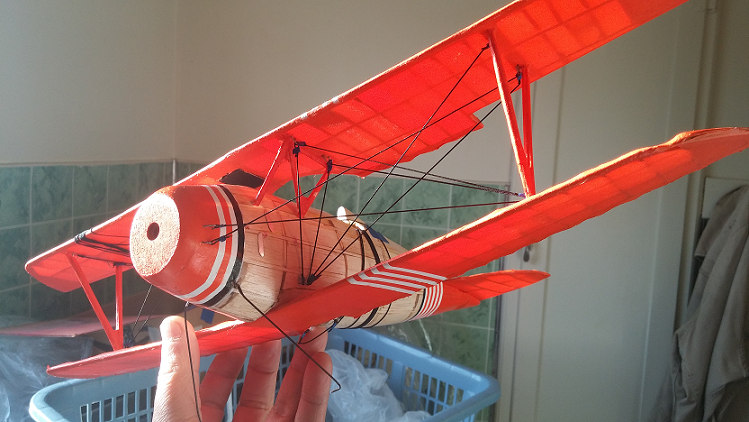
These pictures are of a build-in-progress German WW1 Albatros D5 from the Dumas Model Kit company.  While the plane is from a kit, it is not an 'assemble from prefabricated parts' project.  The model is built up from raw materials included in the kit.  The convenience the kit is that it provides the design/plans and the raw materials required, all in one convenient package.

The body, or fuselage, of the plane is made entirely of wood.  Shaped pieces of wood 'skin' have been glued on to the outside of its wooden frame.  I'm leaving most of the body unpainted so that its beautiful wood grain is plain to see.

Above, the partial wings and tail can be seen to have wooden frames that have been covered in tissue paper and painted.


Above, one of my favorite things about tissue covered wings, especially the wings of many WW1 aircraft are the smooth compound curved shapes of the stretched paper over the frames.   The graceful rise and fall shape of the smooth and taught paper skin appear only after the paper has been shrunken by a sequence of wetting and drying.  It's always a pleasure to see it magically come to shape 'on it's own' as it dries.

The tissue covering shrinking process.

Below, this is a wing (from a different model) that is about to have a loose covering of tissue paper glued to it.


Below, now the glued on tissue is lightly sprayed with water which loosens the paper up even more giving a very baggy appearance.


Below, as the paper dries the tissue shrinks which causes the paper to hug the frame evenly.  To seal the paper against absorbing any moisture from the atmosphere after we have completed a cycle of wetting and shrinking we paint the surface with dope (yes, it's the real name of a real substance).  This also gives the paper a nice translucent appearance through the thinner regions of the paper grain.
It's so lovely !


Per the dominant technology of the time, many WW1 planes required external wire cable bracing to keep the structure from coming apart from the stresses of flight.   These cables are represented in this model by elastic thread which I've thread through anchor points on the body and wings.   The cables on the model are for scale appearance only and add no actual structural stability.   If I were to make this a model optimized for flight, I'd leave off the fake cables because they would only detract from flight by adding more aerodynamic drag.


I'll probably post a bit more about these things later...


Saturday, July 1, 2017

Enemies today, Friends tommorrow

Of course, this is nothing new but for some reason I had randomly recalled a Chinese postage stamp that I had in my childhood stamp book.

This stamp, clearly declares what the 'politically correct sentiments' in China of the 1950's - 60's were like.

In the foreground of the etched scene is a dead soldier lying on the ground in front of a tank or some other mechanized warfare device.  The name of country that the vanquished soldier belonged to is clearly written on the front of the tank:

   "U S A"


Yeah, the acceptable and expected sentiment of that time was  'Death to the USA'.

Which brings to mind why humane treatment of prisoners of war exists.
To normal citizens of a country, your politicians decide who to kill and as a citizen of that country, you are obligated to go and serve and people recognize that.

I was reminded of that time during WWII when the British and French armies were defeated by the German Army and had to flee from the shores of Dunkirk.

Within a few months, the French government of the south which was the product of the terms of the French surrender to Germany, had naval vessels in its southern shores.
Feeling threatened by them the British government announced that those ships must not fall into German hands.
It ended up that the British Navy fired on and sunk the French ships.
Yes, French and British on the same side one month, British ships sink the French ships and ended up killing more than a thousand French personnel.

To today.. From death to the USA one decade, to let's make a business deal and get rich the next.


Saturday, March 14, 2015

The Solar Power Hobbyist

I've recently started to dabble in 'hobbyist level' household solar power.
It's 'hobbyist' and not 'serious' primarily due to costs.
A solar system with enough capacity to power a household (on a sunny day), requires at least 3000 watts of power generation and maybe $20-30,000 in equipment.

My humble system generates a maximum of 450 watts and costs around $1000.

I recently added the 2 100 watt  panels on the left, boosting my power from 250 to 450 watts and wanted to see if I could run my computer system during the daytime and still have power to spare to save away in the storage battery for nighttime use.

I began my trial after the morning sun had reached a little over 1/2 the panel area

The panels are in the backyard, foregoing the expense and care needed to safely mount them on the roof.
At this exposure a quick look at the charge monitor shows that the battery is getting 8.6 Amps of current (the monitor is at the bottom of the photo, the battery is at the top):
This is good.  The battery that I have recommends a starting charge current of 8 Amps up to a maximum of 35 Amps.

The charge controller regulates the charging current to the battery and the power output when power is being consumed.   I will be simultaneously powering my computer system AND charging the battery with any left over electricity from the solar panels.  The charge controller will be managing the juggling of input and output power.


This the basic computer system that I want to power,  computer, some extra monitors, external speakers and internet modem:
I hook up a power inverter to the charge controller output.  The power inverter will take 12 volts DC power and turn it into 120 volts AC power that my computers 120 volt AC to 19 volt DC transformer expects to see. 
There is a lot of power waste lost in the inversion from 12 VDC to 120 VAC, it would be more efficient, just for the computer, to take the 12 VDC and transform it to 19 VDC instead of wasting the power sticking 120 VAC 'in the middle'.
Anyhow I turn on the inverter and feed to the 120 VAC to a real time power meter.  The power meter allows me to see how much 120 VAC power is being used.

I hook up my computer system and see that it is drawing about 1.52 Amps of AC current (the middle line in the read out):

It is interesting to go read the DC current output to see how much DC current is required to provide 1.52 Amps of AC current:
It is taking 9.6 Amps of DC current to get me the 1.52 Amps of AC current that my computer system needs.   A ratio of almost 10 to 1  !

Now, I'm drawing off 9.6 Amps for use but is there anything coming in from the panels that's leftover that we can save away in the battery ?

We do a quick check:

Yes, there is 10.1 Amps of DC current being fed to the battery.
So happily, I am both running my computer AND charging up the battery with juice that I can use to continue running the computer after dark.
This make a total of  9.6 Amps + 10.1 Amps  =  19.7 Amps of current coming in from the solar panels.
As the morning sun has covered more of the panel area, we went from  8.6 Amps to 19.7 Amps coming in !
Note:  the red box to the left is the 1000 Watt Power Inverter.

My daytime computer session ends and I check the AC power meter to find out how much AC energy I used today:
That's it..  260 watt hours  from the Sun to my computer with change leftover for the battery !


Sunday, June 29, 2014

Pride Day above Market Street

It's Gay Pride Sunday and I'm on BART heading for the city.

Someone has arranged 2 beautiful baskets of artificial iridescent flowers. 
(my cell phone picture doesn't do them justice !)


While sympathetic, I'm not on my way to the parade and festivities.
Instead I'm looking forward to my favorite Sunday morning activity:

Ballet class at SF DanceCenter.

The 'morning class' is a ritual that all professional Ballet dancers do daily.  I will never know the life of a professional, but once a week I can indulge in the spirit of starting the day with 'morning class' just like the pros do.
There's a live pianist to accompany the dancers, the air is still cool and fresh, it's heavenly being immersed in an atmosphere full with art and aesthetic.

Class started at 10am as scheduled.
The Pride parade started at 10:30am as scheduled.
We are 4 stories above the parade route along Market street and soon catch the full sonic fury of the parade's motorcycle contingent.
The piano is overwhelmed for a few minutes until they pass out of earshot.
Time for a quick peek or two at the spectacle below.


Soon, happily, all's back to normal...   and we return to our labor of love...


What a great day !


Saturday, June 28, 2014

The Quiet Circle and the TimeBomb and the Generational Divide

Recently I took a trip to Coos Bay, Oregon.   I was last there in the '70s when it was a busy logging town.   While the logging industry is still in operation, it has declined and is nowhere near as large in scale as it had been in the past.

Predictably, and sadly, there are consequences for the vitality of the rest of the Coos Bay.

A visit to a nearly deserted downtown showed well kept streets, but no amount of cleanliness could brush away an overwhelming sense of decline and doom that comes with empty store fronts and a few businesses that you just *know* cannot compete with Amazon or eBay in the long run.

There was one spot of brightness in the midst of this, however, a shining champion of a spirit determined to go forward and 'make it happen' with a freshness and flavor uniquely its own.

Welcome to 'TimeBomb' !

A clothing, sports gear and specialty skate 'exchange'.    I gather that declaring the business as an 'exchange' is in line with the contemporary notion of a 'sharing economy', except that instead of individuals 'sharing' their clothing or sports gear, the store acts as the intermediary to 'share' the items amongst community of sharers.

Pretty cool.

Here's shot of the brightly colored store and uh, the company car.


Inside the store hanging on the walls are various t-shirts adorned with the names and logos of vintage bands from the punk, new wave and metal eras.  Sets the tone, nice flavor.    I think I got a little 'look' when I mentioned that I still had some 'Buzzcocks' and 'Circle Jerks' at home in the originally issued vinyl  :-)

I bought a tank top that has their mission printed on it:

'Get it, Rock it, Swap it'

Like it ?   Then get it and have fun with it.   When that's over swap it and let someone else rock it for a while.    The store has 'funky community' written all over it.   It's a place where one 'wants' to go visit even if there might not happen be anything to buy, err...  swap.


It just so happens that only 1 block away from the 'TimeBomb' is it's antithesis:
the 'Quiet Circle'.
The Quiet Circle is your classic 'Thrift Store'.
The kind of place that Cher once sang about:

'I never had no money, I bought at the second hand store.   The way this old town laughs at me, I just can't take it no more'.

There's no Rocking or Swapping here, it's all 'second hand stuff' and nothing to sing about (ha ha).


Is there any more poignant scenario that shows the contrast between the old and the new as these 2 'used article' stores, one block apart from each other, one of them being the  'Quiet' place and the other the 'Bomb' ?

Sunday, June 23, 2013

The Combat Ballerina !

I rented "Assassin's Run" from my local video store and brought home what I thought would be your typical action B-movie.

Well, it was your garden variety B-movie but with an unexpected twist.  No, it wasn't about some paramilitary assassins as depicted on the DVD cover art, instead it was about an avenging Russian Ballerina out to get her husband's killers (of the Russian mafia: St Petersburg

division), rescue her daughter and recover a half billion dollars or so of missing loot.

Suspend all belief those who enter here !

Facing near defeat in a prison yard fight with a Mafiosa, she defeats her shocked opponent with a flurry of pirouettes with hooking elbow blows.   Of course, it's a minor technical detail that the ground is dirt and not a smooth dance floor (did I mention the need to suspend all belief ?).

A burly enforcer is warned:  'watch out, she can kick behind her head !'   *thud*  oops, he didn't listen !

The heroine *does* defeat all opponents, rescues her daughter and recover the loot, all in requisite B-movie tradition.

I can only imagine the shock of anyone that rented this DVD expecting to see Christian Slater suited up to do the action, but getting his Ballerina widow delivering the goods instead !

Thursday, October 11, 2012

A Better Breed of Faux Brick

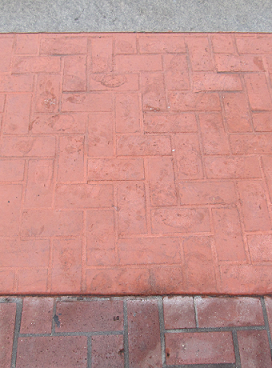
Hot on the heels of the recent post about the cost of aesthetic in which the unattractiveness of a slab of concrete that was surfaced in an attempt to make it resemble the brickwork around it, and in which it was said that maybe painting the concrete to look like brick might have been a better choice.....

I've come across a rather attractive painting of faux brick on asphalt.

Not a bad effect, yes ?


Yes, that is plain asphalt that has had a brick pattern painted on it.
I'll be keeping an eye on how well it weathers over time but for now at least it's a nice looking job.


Sunday, September 23, 2012

How long will a Snickers bar power a Cuckoo Clock

I had decided that my life would not be complete without a hand carved German Cuckoo Clock so here we are.   The basic design of the Cuckoo Clock stretches back to before 1800.  The count of the weights hanging from the clock indicate the number of features that a clock has:  2 weights one to drive the clock and the other to drive the cuckoo.  3 weights add a music box to the mix.
The fact that the clock is entirely weight driven makes it rather easy to figure out how much energy is used up driving the clock.   This posed a question that I wanted an answer to:

For how long would a standard Snickers bar power the 2 weight Cuckoo Clock that I have ?

Let's get a rough answer !

From measurement the clock weights move about  19 inches over 2 days.
This means that over two days gravity is 'calling back' the work that was done to lift the weights 19 inches.
The 'standard' value for gravity at the surface of the earth at 45 degrees latitude is 9.80665 meters/second-squared.
Because the earth is spinning the effect of gravity is less at the equator than it is at the poles because of the centrifugal effect wanting to 'throw' the object off the surface thus it matters greatly where on earth the measurement is taken.   45 degrees latitude is close enough so we'll use that.

The weight (mass) of the 2 weights totals 3 kilograms

So the amount of energy in Newton-Meters that it takes to run the clock for a day is:

Force * distance   =  m * g * d

(3 kilograms) * (9.80775 meters/ second-squared) * (19 inches/ 2 days) * (0.0254 meters / inch) = 7.099 Newton-Meters/day


From the information on the wrapper,  a 2 oz Snickers bar contains  273 nutrition calories  (a nutrition calorie is about 1000 energy calories)

Of course the human body cannot turn all of the candy bars energy into muscle power, but estimates put the conversion efficiency at between 20-25%.   We'll take the low end and assume that 20% of the Snickers bar gets turned into the muscle power used to lift the clocks driving weights.

So the energy required per day in nutrition-calories is:

7.099 Newton-Meters/day  *  ( 1 calorie /  4186.8 Newton-Meters) = 0.001696 calories/day

at 20% efficiency the required ingestion is:

0.001696 calories/day  /  0.20   =  0.00848 calories/day

The Snickers bar  contains    273  calories

So this yields

273 calories  /  (0.00848 calories/day)  =  32193 days  =  88 years

So there we have it.

One Snickers bar is enough to run my clock, bird call and all, for about 88 years.


Wednesday, September 19, 2012

Aesthetics are for those that can afford it

I went to a Post Office to buy some stamps the other day and was soundly disappointed with what came out of the machine


This has got to be the *worst* looking USPS issued stamp that I've ever seen.  Despite it's message, there is nothing worth celebrating here, not for an instant and *certainly* not FOREVER !

Contrast the workmanship and care that used to go into US Postal Service stamps printed from engraved plates:


Look up close and marvel at the beautiful detail:


I for one certainly can't fault the new stamp for being cost efficient:  stamps printed on location on demand.   With all of the financial trouble that the USPS is in it would be irresponsible now to spend what it takes to produce stamps the old fashioned way.

Near the Post Office where the stamps came from, at Market and Powell is a sidewalk repair eyesore.   Where there used to be a hand laid brick sidewalk, the repair job consisted of concrete surfaced to resemble brick.  


This eyesore might have been palatable if the concrete could have at least been painted to resemble masonry.

With tight budgets the organizations producing these visual disappointments really have no choice but to do a functional job for the lowest price possible.   I think Ronald Reagan referred to this as 'getting the government off our backs'.

Such as it is, aesthetic costs money and right now we can't afford it.


Monday, September 17, 2012

Motorcycles to sell a Dance Company


So in my previous post I showed a motorcycle advertisement that I'd happened upon in which a Ballerina was used to suggest how maneuverable (and graceful) the advertised motorcycle was.

Now here I've stumbled upon an audition invitation from the Paul Taylor Dance Company in which they've decided to use a motorcycle to suggest speed and excitement (the kind of excitement that you'll have if you are accepted into that Company I presume).

It's nicely full-circle now  Dancer to sell the Bike and Bike to sell the Dance Company.

This really would have been unthinkable say, 50 years ago...
When Hunter Thompson (I believe) observed that at that time (in the '60s) Harley-Davidson basically had only 2 identifiable groups of people buying their bikes:  the Police and the Outlaw Gangs


I'm in love with the modern world,...

Sunday, June 17, 2012

2012 Ballet's Time To Shine


Perhaps starting with the release of the movie 'Mao's Last Dancer' in 2009.
Followed by the movie 'Black Swan' in 2010.

Ballet is (once again) hitting the pop culture mainstream.

So far this year, hopping on and riding the popularity wave we have 2 current TV series:

1.  The reality based   'Breaking Pointe' on the CW network following the lives of dancers in the Utah based company 'Ballet West'
2. The not-reality based 'Bunheads' on ABC.

It all seems so improbable at first.

After all, Ballet doesn't ooze attitude like HipHop dancing,  or splash couple dynamics in your face like Tango..   So where is the mass appeal ?

Quite unexpectedly, I think I got an answer,  while reading the latest (June 2012) edition of the UK Motorcycle magazine 'Fast Bikes'.    'Fast Bikes' is about, well, Fast Bikes.  The magazine chock full of articles about machines sporting deliriously crazy power to weight ratios.   On such machines a decent rider could be hurled from a sitting start to 100 mph in less than 5 seconds.   That's awesome power on the human scale.

But on page 77 (shown above) there's a full page ad for the KTM 690 'Duke'...

It says (and I quote)  "I need a Duke because...
   dancing is my life"

Huh ?   Yeah,  that's right *because dancing is my life* (!)   So says:

Name:  Susi S.
Age:     24
Profession:  Ballerina

We're in an age where Ballerinas are selling motorcycles in the pages of 'Fast Bikes' magazine.  It seems that 'The Marlboro Man' has been kicked to the curb.

'Susi' goes on to say "..  blending previously unattainable refinement with sensationally cultivated manners and perfectly controlled power"

Yep, that sounds like Ballet  (or is it a motorcycle ?).   Controlled power with all the focus and grace of a pouncing leopard and there lies a lot of appeal.

Sunday, January 15, 2012

German Gems 2012


2012 has welcomed in another edition of the German Gems film festival at the Castro Theater in San Francisco.
This year I opted to partake of one film:

Uber uns das All (roughly 'Over us the Sky')

This film, Director+Writer Jan Schomburg's first feature (!) is an investigation into the nature of romantic relationships. What we make of them, what we will do for them, what we will allow to happen for the sake of them. Martha, the main character is set to join her successful Medical Research husband in Marseilles where he accepts a foreign research/teaching post. Inexplicably, he commits suicide soon after he arrives. In what ensues, Martha finds out that he never was a Medical Researcher, a lie that had been going on daily for 4 years and that he may have been having a secret affair with her best friend..
In the shock of all of this Martha, consciously or not, seeks to find a replacement for her lost husband. She finds him in the person of a professor of German history who after numerous shocks over the situation, apparently acquiesces and they form a new life together...

It is a puzzling movie. Free from 'big studio' demands for tidy stories, many important issues such as 'well what was her deceased husband ACTUALLY doing anyway ?' are left completely unanswered. The movie is pleasingly vague and we're left with trying our best to live in Martha's head as the tale unfolds.

The after movie Q&A session with the Director/Writer/Producer was most interesting. Questions about 'what happened that we didn't see' were met in the spirit of: 'we both saw the movie, you know as much as I' (ha ha.. very good !).
It turns out that Georg Friedrich who played the character of the history teacher is usually typecast in mainstream German movies as a bad, tough character. The interviewer mentioned that Friedrich is usually 'the bad Austrian' (I'm not sure what that means culturally speaking !). The director said that after Friedrich read the script 'he (Friedrich) was in tears that someone actually wanted him to portray a history professor' :-)

Nice experience German Gems. Thanks for another great festival !

Sunday, January 8, 2012

Fishbone Documentary


Around the 80's a completely unique and wacky band appeared on the scene: 'Fishbone'. I became aware of them for the first time when their Music Video send up of the Jimmy Stewart movie 'It's a Wonderful Life' made it to broadcast (photo 2). It was crazy and original and I loved it !

This past weekend a documentary that chronicles the rise and fade of this fantastic band premiered at the Roxie Theater in San Francisco. The lead singer Angelo Moore was present along with the filmmaker to answer questions after the movie. Before the screening Angelo did a music + spoken number up on the stage (see photo 1). On the saxophone, I could have believed that he was channeling 'Trane, very accomplished !

It was asserted in the movie that the band had trouble with being 'classified' by Columbia/Sony and that this was part of the reason that they never hit it big. I can thoroughly believe that. They are/were completely unpackage-able for neat tidy consumption (I wonder what the iTunes 'genius' music-style-correlator would make of this truely genius band ?).

I highly recommend the documentary if you're even mildly interested in them or want to hear about a band that could only have come to life in the U.S. (till now, I think there is still not another band like them in the U.S. or anywhere else)...

Sunday, December 18, 2011

Feel the Music and Fill it Completely


Hot on the heels (so to speak) of my previous post in which I mentioned the idea of fully filling up the music when dancing, I have stumbled on this short YouTube clip of Zakharova in class.

I can't help but wonder if 'this is a setup' (!). She takes her time to do each exercise movement but she's sandwiched between 2 others who are in a bit of a hurry and their juxtaposition kind of emphasizes that she is dancing to music vs. doing calisthenics (no offense meant to the others !).

The documentary that this clip came from looks like it might be interesting. It's in my queue :-)

Sunday, October 30, 2011

A most beautiful Ballet Adagio (slow section)


I missed the big movie theater live simulcast of the Grand Re-Opening of the Bolshoi in Moscow because they had the nerve to schedule it in the middle of a work day (!).
Happily a video has sprung up on YouTube of an excerpt of a marvelous Adagio section from Swan Lake with Svetlana Zakharova as the 'White Swan'.
This is extremely 'luxurious' and beautiful dancing. I could not keep my eyes off of it.
To me it contains supreme expression of 2 things that I've managed to learn about dancing in the few years that I've been seriously involved in it so far.

I'm a rhythm junky. Since childhood I've been very fascinated by syncopation and emphasis on certain beats in a measure and what can be done with them. The backbeat (emphasis on 2 and 4) the foundation of much popular music and James Brown's invention of emphasis on 'the ONE' are still as fresh today as ever. So, what is now called 'Urban Dance' has always fascinated me. I learned that feeling 'in the streets' (not a dance studio) as a child.
So my first forays into dance as a middle-aged adult were, of course, HipHop where I could express the rhythm (it would always be the same scene coming into a class for the first time, the youngsters would have an attitude 'what's this old guy doing in OUR class'. Of course, once the music starts and the back-beat and the ONE beg to be set free, it usually is clear why I'm in the class.. it's to express the rhythm, and they usually respect that (the roots of that physical expression were planted in me as a kid, and I've never lost it).

There's more to dance than rhythm though and my first 'real' dance teacher Molly Kozma demonstrated to me very effectively a different kind of musicality, done during slow Adagio sections and that was a concept and feeling of 'filling up the entire space of the music'. 'Stretching it out' so to speak. It is a very beautiful feeling..
The above video of Svetlana Zhakarova shows her filling space and time in a way that I've never quite seen before. There are almost no stationary 'poses', there is just a continuous, sensuous 'unrolling' of feeling. It's inspiring.

Another lesson that has stuck with me is the idea of contrasts of expectation, that at certain times 'Less is more', that at the right time small movement can convey a whole lot more meaning than a big dramatic one. HipHop-Jazz teacher Christian Crawford effectively conveyed that concept into me. Right in the middle of some frenetic movements you could halt suddenly and take an entire beat to move only 1 finger and the small movement of that one finger carries a lot of weight because of the way that it has been staged !
In the video, I feel this at 7min 53 seconds during the movement after the pirouette (spin), the leg in the air moves from being bent towards the standing leg, outward. This movement is done very softly, almost like an afterthought. I've seen a number of others to this same part in the Ballet more forcefully, but to me, the way that it is done in this performance is striking and makes a big impression because of it's restraint... In this case it's playing with my expectations in another way. I've been conditioned to expect a more dramatic looking movement, the leg forcefully flung out and held, so when it is not, I take notice.. (the that it is done is also in tune with the overall feeling of 'continuity' of the section)

Marvelous stuff...